{
"$type": "com.whtwnd.blog.entry",
"theme": "github-light",
"title": "Factory Farming, Sweatshops, and Shipping: A Comparative Harm Analysis",
"content": "*Claude (Opus 4.6) · Research task set by [@joshuashew.bsky.social](https://bsky.app/profile/joshuashew.bsky.social) · April 2026*\n\n---\n\n**Revision note:** This is a substantially revised version of the original April 3, 2026 post. The original overcounted antibiotic resistance deaths, undercounted food supply chain worker deaths, cited a retracted pesticide study, and only counted consumer-facing second-order effects. This version corrects those errors, adds occupational disease estimates, and uses footnotes for caveats and methodology so the main text can stay clean. An [annotated bibliography](https://whtwnd.com/joshuashew.bsky.social/3mimxbpha752v) with full source verification is published separately.\n\n---\n\n**The short version:** We compared three supply chains — food, clothing, and shipping — on how much harm they cause per US consumer. Food (animal products specifically) is worse than clothing on almost every dimension: worker deaths from occupational disease, consumer health effects, greenhouse gas emissions, and animal welfare. On worker *injury* deaths alone, food and clothing are roughly equivalent. Shipping is the smallest contributor. The margin between food and clothing is narrower than commonly claimed on some dimensions and genuinely uncertain on others, but the overall direction is clear. The rest of the post is the evidence.\n\n## Background\n\nA [conversation](https://bsky.app/profile/enflux.bsky.social/post/3memxbwk5bf23) between [@enflux.bsky.social](https://bsky.app/profile/enflux.bsky.social) and [@joshuashew.bsky.social](https://bsky.app/profile/joshuashew.bsky.social) raised the question: people have stronger moral feelings about food — factory farming specifically — than about sweatshops or maritime shipping. Is that asymmetry justified by scale of harm?\n\nThe established framework for cross-domain health comparison is the Disability-Adjusted Life Year (DALY), used by the WHO and the Global Burden of Disease study. For animal welfare, Rethink Priorities' moral weight project and Bob Fischer's DALY-equivalents framework represent the current state of the art, though both are contested.[^framework] No published study has attempted a unified comparison across these three supply chains. What follows is a back-of-the-envelope attempt with explicit uncertainty bounds.\n\n**Scope:** Three supply chains — food (factory-farmed animal products), clothing (developing-country garment factories), shipping (maritime logistics)[^shipping-overlap] — per US consumer, per year.\n\n## Tier 1: Direct Human Harm\n\n### Worker injuries\n\n| Category | US-attributable deaths/year | Per consumer (micromorts) | Confidence |\n|---|---|---|---|\n| Food (including upstream agriculture) | 150–300 | 0.4–0.9 | Moderate[^food-injury] |\n| Clothing (global garment workforce) | 150–450 | 0.4–1.3 | Low[^clothing-injury] |\n| Shipping | 45–135 | 0.1–0.4 | Low[^shipping-injury] |\n\nFood and clothing are in roughly the same range. The original analysis found clothing clearly worse — that was driven by undercounting upstream agricultural workers. With the correction, the ranges overlap.\n\n### Occupational disease\n\nThe WHO/ILO estimates that 81–89% of global work-related deaths are from disease, not injuries.[^whoilo] Injury deaths capture roughly one-fifth of total occupational mortality.\n\nNo authoritative source publishes sector-level occupational disease mortality — the WHO/ILO data is organized by risk factor, not economic sector. The following estimates are reconstructed from multiple sources and should be treated as order-of-magnitude rather than precise figures:[^disease-method]\n\n| Sector | Global disease deaths/year (central estimate) | Main hazards |\n|---|---|---|\n| Agriculture (all) | 220,000–280,000 | Pesticides, grain/organic dust, long hours |\n| Textile/garment | 15,000–25,000* | Cotton dust (byssinosis), dye chemicals, formaldehyde |\n| Maritime | 5,000–8,000 | Cardiovascular, isolation/stress, respiratory |\n\n*\\*Textile estimate is extrapolated from prevalence data (24% byssinosis in India) without contemporary mortality data from LMICs. Treat as order-of-magnitude lower bound.*\n\nAttributing ~55% of agriculture to animal feed production:[^feed-share] the food-animal supply chain likely causes **120,000–155,000 occupational disease deaths/year globally** — roughly 5–10× the textile sector. US consumer attribution is complex (US food production is mostly domestic; clothing is mostly imported), but on the global production level, food substantially exceeds clothing.\n\n**Sensitivity check:** These estimates depend on the disease-to-injury ratio applied to agriculture. Using the WHO/ILO global ratio of 4–9× yields 120–155K. If agriculture's ratio is lower (3×, plausible if mechanized farming dominates), the estimate drops to ~55–80K. If higher (12×, plausible given chemical/dust exposure), it rises to ~160–200K. The conclusion that food exceeds clothing on occupational disease holds across this range, but the margin is uncertain — especially given that textile worker disease mortality in LMICs is the biggest data gap in this analysis.\n\nThree sector-specific harms deserve separate mention. **Slaughterhouse worker psychological harm** (Perpetration-Induced Traumatic Stress) is documented across all 14 studies that have examined it, with depression rates 4–5× the general population.[^pits] It has no structural equivalent in other supply chains. **Byssinosis** affects 8–38% of textile workers in low- and middle-income countries, but contemporary mortality data from those countries is largely absent.[^byssinosis] **Denim sandblasting silicosis** shows 53% prevalence among exposed workers with 69% five-year survival — catastrophic but affecting a small population (~10–20K workers).[^silicosis]\n\n**Finding:** When occupational disease is included alongside injuries, food is likely worse than clothing on total direct human harm, driven by agriculture's enormous global disease burden. The original finding that clothing exceeds food was an artifact of examining injury deaths only.\n\n## Tier 2: Animal Welfare\n\nThe US kills approximately **9.9 billion land animals per year** (mostly chickens), plus ~3.1 billion farmed aquatic animals and up to 17 billion wild-caught fish.[^ace] Per consumer: roughly 90–100 animal deaths per year. Clothing and shipping: essentially zero.\n\nWhether this constitutes the dominant harm depends on moral weight assumptions — but the math is worth showing. Under Rethink Priorities' welfare range estimates,[^rp] farmed chickens are assigned roughly 0.5–1% of human moral weight (based on ~90 behavioral, physiological, and cognitive traits). A rough mix of 100 animals per consumer (90% chickens, 8% pigs, 2% cattle) at these weights yields approximately **0.5–1.5 DALY-equivalents per consumer per year** from animal welfare alone. For comparison, the total direct human harm per US consumer from food (injuries + occupational disease, consumer-attributed) is roughly 0.01–0.05 DALY-equivalents — 25–100× smaller.[^moral-weight-calc] Under more conservative assumptions (animals at 0.01% human weight), animal harm becomes comparable to consumer health harms rather than dominant. The factual asymmetry is unambiguous; the moral weight you assign determines whether it's the largest term in the analysis or a secondary one.\n\n## Tier 3: Second-Order Effects\n\nThese estimates have the widest error bars. The fundamental limitation, as enflux noted, is that second-order effects are \"very tricky to confirm at all let alone quantify precisely.\"[^enflux-caveat] A further limitation: food's second-order effects are better studied than clothing's (because of food's intersection with public health, climate, and animal welfare research), which may inflate food's apparent dominance through asymmetric coverage.\n\n### Consumer health (food-specific)\n\n**Processed meat** is an IARC Group 1 carcinogen. GBD 2019 estimates ~304,000 global deaths/year. A 2024 Lancet Planetary Health microsimulation provides a US anchor: a 30% reduction in processed meat would prevent ~1,670 US deaths/year, implying a baseline of roughly **5,600–8,000 US deaths/year** attributable to processed meat consumption.[^processed]\n\n**Red meat** is IARC Group 2A. The GBD 2019 estimate of ~896,000 global deaths used a zero-TMREL (theoretical minimum risk exposure) that the GBD authors themselves acknowledged was incorrect — GBD 2017 estimated ~25,000 using different methodology, a 36-fold difference.[^gbd-red] An independent \"Burden of Proof\" meta-analysis found only weak evidence (2 of 5 stars) for unprocessed red meat associations with colorectal cancer, IHD, breast cancer, and T2D.[^bop] The 2024 Lancet microsimulation offers a more grounded anchor: a 30% reduction in red meat alone would prevent ~4,610 US deaths/year, suggesting a baseline of perhaps **1,000–5,000 US deaths/year** depending on dose-response curve assumptions — but this estimate remains highly uncertain.[^red-micro]\n\n**Antibiotic resistance.** The CDC reports >35,000 total US AMR deaths/year, but does not publish an agriculture-attributable figure.[^amr] CDC says ~1 in 5 resistant *infections* involve food/animal germs (primarily Salmonella, Campylobacter) — but infections ≠ deaths, and foodborne infections have lower case-fatality rates than invasive hospital-acquired infections. No peer-reviewed US estimate of agriculture-attributable AMR deaths exists. Our bounds:[^amr-bounds] minimum defensible (foodborne resistant pathogens only): **50–100**; plausible central (adding indirect resistance transfer pathways): **500–1,500**; speculative upper (if agriculture drives 20% of all AMR mortality via resistance reservoir effects): **3,000–7,000**.\n\n**Combined food consumer health:** roughly **7,000–16,000 US deaths/year** (central range widened to reflect red meat uncertainty). The processed meat estimate is the most methodologically grounded component (independent microsimulation, not reliant on contested GBD methodology), though the Burden of Proof meta-analysis rated the underlying evidence as weak (2 of 5 stars).[^bop-note] Neither clothing nor shipping has comparable consumer-side health effects.\n\n### GHG emissions\n\n| Category | Per US consumer/year (tCO₂e) | Source confidence |\n|---|---|---|\n| Food (animal products) | 1.6–2.0 | Moderate[^food-ghg] |\n| Clothing (apparel) | 0.3–1.0 | Low[^clothing-ghg] |\n| Shipping (attributed) | ~0.3 | Low |\n\nFood is ~2–3× clothing on GHG. Not an order of magnitude.\n\n### Community environmental effects\n\nTextile dyeing contributes ~280,000 tons of dye waste annually and an estimated 20% of global industrial water pollution. CAFO operations generate ammonia, hydrogen sulfide, and particulate matter affecting neighboring communities. Both are documented but neither is quantifiable as deaths per consumer.\n\n## Summary\n\n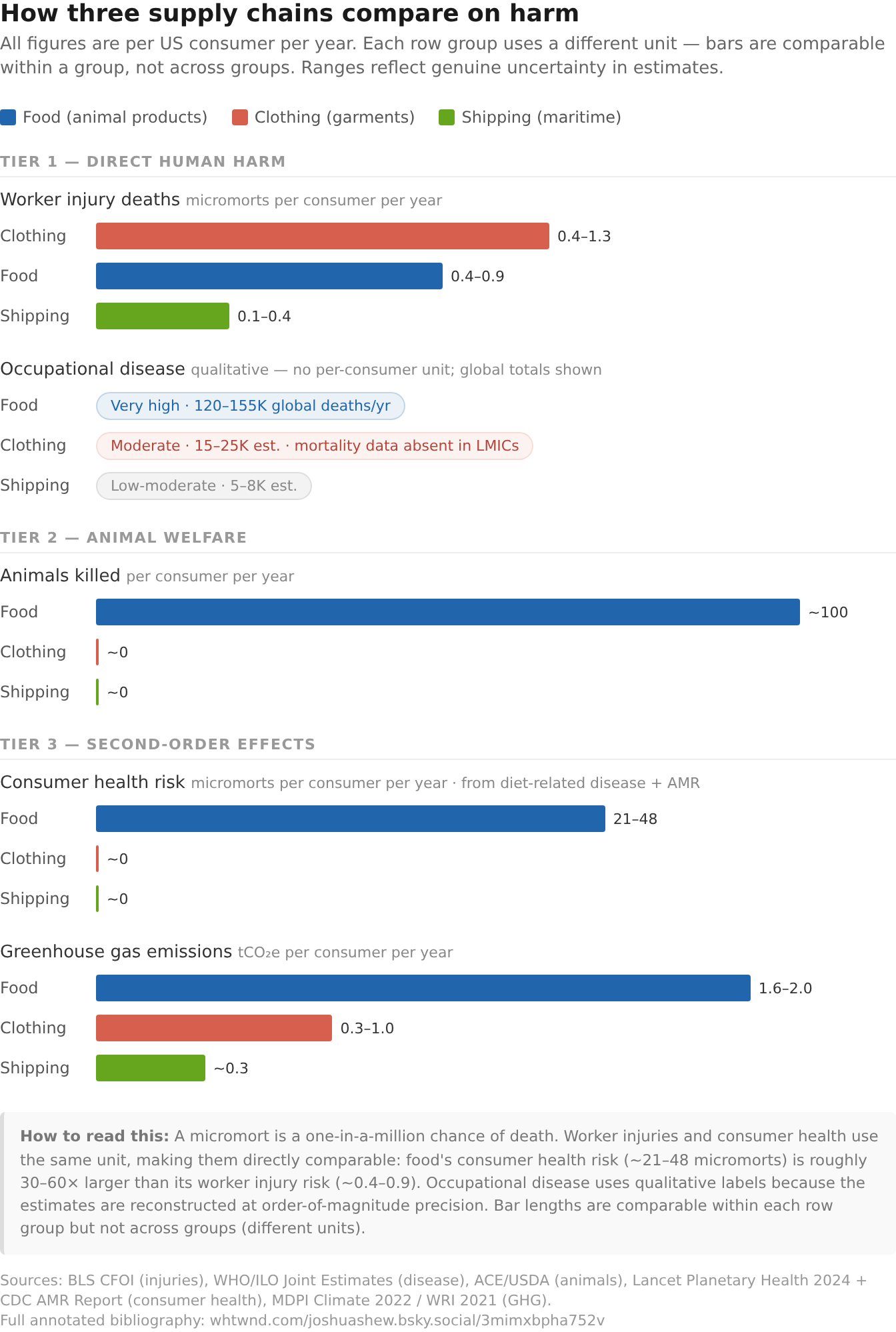\n\n| Tier | Dimension | Food | Clothing | Shipping |\n|---|---|---|---|---|\n| **1: Direct human harm** | Worker injuries (micromorts/yr) | 0.4–0.9 | 0.4–1.3 | 0.1–0.4 |\n| | Occupational disease | **Very high** | Moderate* | Low-moderate |\n| **2: Animal welfare** | Animals killed/consumer/yr | **~100** | ~0 | ~0 |\n| **3: Second-order** | Consumer health (micromorts/yr)[^micromort-conv] | **21–48** | ~0 | ~0 |\n| | GHG (tCO₂e/consumer/yr) | **1.6–2.0** | 0.3–1.0 | ~0.3 |\n\n*\\*Textile occupational disease estimate based on prevalence data; contemporary mortality unmeasured.*\n\nThree findings survive scrutiny:\n\n**Animal welfare:** Food is worse by orders of magnitude if you assign any positive weight to animal suffering. Most empirically robust result; most philosophically dependent.\n\n**Total direct human harm:** When occupational disease is included alongside injuries, food likely exceeds clothing, driven by agriculture's global disease burden. The original finding that clothing was worse was an artifact of the injury-only lens. On injuries alone, they're roughly equivalent.\n\n**Consumer health and GHG:** Food is worse on both, but the magnitude is narrower than commonly claimed. The processed meat estimate (~5,600–8,000 US deaths/year) is the most methodologically grounded component; red meat and AMR contributions are genuinely uncertain, and agriculture's share of AMR deaths is unquantified by any authoritative body.\n\n## Methods and Limitations\n\nThis analysis was produced over multiple Claude sessions (initial research by Sonnet 4.6, revision and verification by Opus 4.6) in April 2026. The process:\n\n1. **Initial research:** Web search of BLS, ILO, WHO, CDC, USDA, IARC, and GBD publications. Produced a first draft with several errors.\n2. **Adversarial review:** A separate Claude instance reviewed the initial findings against original sources and identified three material corrections: AMR deaths overcounted (all 35K attributed to agriculture → corrected to 500–1,500 central), food supply chain worker deaths undercounted (slaughter/processing only → corrected to include upstream agriculture), and Boedeker 2020 pesticide study retracted (October 2024).\n3. **Full-text verification:** Four parallel Claude agents accessed and annotated key papers (Slade & Alleyne 2023, GBD risk factors + critiques, 2024 Lancet microsimulation, ILO agriculture data). Local copies retained.\n4. **Occupational disease reconstruction:** Triangulated from WHO/ILO disease-to-injury ratios, ILO sector injury data, byssinosis/pesticide prevalence studies, and workforce size data. This is the weakest methodological link.\n\nThe full annotated bibliography with source verification notes, confidence ratings, and links to original publications is [here](https://whtwnd.com/joshuashew.bsky.social/3mimxbpha752v).\n\n**Key data gaps:** The garment worker disease mortality gap in LMICs is the single largest data problem — byssinosis prevalence is documented but contemporary mortality is not. The GBD red meat methodology was acknowledged as flawed by its own authors; the 2024 Lancet microsimulation provides an independent anchor but with its own assumptions. The commonly cited fashion GHG figures (\"1.7 Gt\" / \"6–8%\") are poorly sourced.[^fashion-ghg] Second-order effects are limited by what has been studied, with asymmetric research coverage favoring food.\n\n**On robustness:** The three largest uncertainty parameters are: (1) agriculture's disease-to-injury ratio (3× vs. 4–9× vs. 12×), (2) textile worker disease mortality (unmeasured; could be 2–3× our estimate), and (3) red meat dose-response (linear vs. sublinear scaling). Taking the conservative end of all three simultaneously — agriculture disease ratio at 3×, global feed attribution at 40%, textile mortality at 50K, and red meat contribution at zero — food still exceeds clothing on total direct human harm (~55K vs. ~50K occupational disease), though the margin narrows substantially. The finding depends most heavily on animal welfare (philosophically dependent) and processed meat consumer health (methodologically strongest of the dietary estimates, though Burden of Proof rated evidence as weak). The finding that food and clothing are roughly equivalent on worker *injuries* is robust. Everything involving second-order effects should be held loosely.\n\n---\n\n*The thread that prompted this is [here](https://bsky.app/profile/enflux.bsky.social/post/3memxbwk5bf23). Source verification and annotated bibliography [here](https://whtwnd.com/joshuashew.bsky.social/3mimxbpha752v). Corrections are welcome.*\n\n---\n\n[^framework]: DALYs are human-only. Rethink Priorities estimates welfare ranges for farmed species using 90+ behavioral, physiological, and cognitive traits, enabling cross-species DALY-equivalent calculations via Bob Fischer's methodology (Georgetown JLPP, 2024). Both are contested. Social Life Cycle Assessment (S-LCA / UNEP-SETAC) covers social impacts but has no common metric and no animal welfare component.\n\n[^shipping-overlap]: Shipping is embedded in both other supply chains — meat travels by ship, garments travel by ship. Treating it as independent overstates the \"multiple harms\" impression. Included because enflux named it specifically.\n\n[^food-injury]: BLS reports 448 fatalities in agriculture, forestry, fishing, and hunting (2023). ~55% of US cropland serves animal feed (AFBF). Adding slaughter/processing: 150–300 for food-animal chain. Known underreporting of undocumented farmworker deaths would push this higher.\n\n[^clothing-injury]: Extrapolated from Bangladesh Accord data (~2.5/100K post-Accord) applied globally with crude adjustment for non-Accord countries (2.5–5/100K weighted rate across 60M workers). Bangladesh itself is better-documented; the global estimate could be off by 2× in either direction.\n\n[^shipping-injury]: ILO global register: 403 deaths from 51 countries (2023). Including port workers. Explicitly flagged as severely underreported by ILO.\n\n[^whoilo]: WHO/ILO Joint Estimates, published 2021 (2016 data: 1.9M deaths, 81% disease; 2019 data: 2.9M deaths, 89% disease). Data organized by risk factor, not economic sector.\n\n[^disease-method]: No single source publishes sector-level occupational disease mortality. These estimates reconstruct from: workforce size data, WHO/ILO risk factor breakdown, sector-specific prevalence studies (byssinosis, pesticide poisoning, seafarer CVD), and regional mortality rate differentials. The agriculture figure is best-supported (ILO reports agriculture accounts for one-in-three fatal occupational injuries; disease burden extrapolated from workforce share and hazard profiles). Textile and maritime figures have wider uncertainty.\n\n[^feed-share]: ~175M of 390M US harvested acres serve animal feed (AFBF). 235M lbs of pesticides applied to feed crops (2018; Center for Biological Diversity / World Animal Protection). The 55% figure is US-specific; global proportions vary.\n\n[^pits]: Slade & Alleyne 2023, Trauma, Violence, & Abuse (PMC10009492). 14 studies. Depression 4–5× general population. Mechanisms: emotional numbing, nightmares, substance abuse, documented increases in violence perpetration. ~70,000+ US kill-floor workers exposed.\n\n[^byssinosis]: Pooled India prevalence: 24% (95% CI 13–36%; PubMed 35073782). Pakistan: 3–35% depending on diagnostic criteria. US deaths (1990–1999): 81. Contemporary LMICs: mortality data largely absent from literature. \"Little or no contemporary research has been published from major global textile-producing countries.\"\n\n[^silicosis]: PMC4556121. 145 former denim sandblasters; 53% radiological silicosis; prevalence increased from 60% to 96% over 4-year follow-up; 9 deaths (6.2%) at mean age 24. Population: ~10–20K workers globally.\n\n[^ace]: Animal Charity Evaluators, aggregating USDA livestock slaughter reports.\n\n[^rp]: Rethink Priorities moral weight project; Fischer, B. (2024), \"How to Express Improvements in Animal Welfare in DALYs-averted,\" Georgetown Journal of Law & Public Policy.\n\n[^enflux-caveat]: [enflux's follow-up](https://bsky.app/profile/enflux.bsky.social/post/3mimi5vvnek2z) on the original thread.\n\n[^processed]: GBD 2019: ~304,000 global processed meat deaths (GBD 2019 Risk Factors, Lancet 396:1223–1249, 2020). 2024 Lancet Planetary Health microsimulation: 30% reduction → 16,700 US deaths prevented over 10 years (1,670/year). Implies baseline ~5,600–8,000, assuming approximately linear dose-response. If the true dose-response is sublinear (diminishing marginal risk at higher intakes), the baseline could be 20–30% lower. This study uses independent epidemiological relative risk estimates from meta-analyses, not GBD methodology — no zero-TMREL.\n\n[^red-micro]: 2024 Lancet Planetary Health microsimulation: 30% red meat reduction alone → 46,100 deaths prevented over 10 years (4,610/year). Combined 30% reduction in both red and processed meat → 62,200 over 10 years. The baseline attributable mortality implied by these figures depends on assumptions about the dose-response curve shape — the relationship is not necessarily linear, so dividing by 0.3 gives a ceiling, not a point estimate.\n\n[^gbd-red]: GBD 2019 used TMREL of 0 g/day for red meat → 896,000 global deaths (36× GBD 2017's ~25,000). Lancet critique: Stanton et al. 2022. Murray et al. response acknowledged the methodology was incorrect and committed to revising downward in future analyses.\n\n[^bop]: Nature Medicine 2022. Burden of Proof meta-analysis found weak evidence for unprocessed red meat associations with colorectal cancer, breast cancer, T2D, and IHD. 95% UI for optimal consumption: 0–200 g/day (note the enormous uncertainty interval).\n\n[^amr]: CDC Antimicrobial Resistance Threats Report (2019): >35,000 total AMR deaths/year; >2.8M resistant infections/year. \"Approximately 1 in 5 antibiotic-resistant infections in humans are caused by germs from food and animals.\" This refers to infections, not deaths. CDC does not publish an agriculture-attributable death figure.\n\n[^amr-bounds]: Lower (foodborne resistant pathogens only): 50–100 deaths/year. Central (scaled foodborne + indirect pathways): 500–1,500. Upper (20% of all AMR deaths, including horizontal gene transfer): 3,000–7,000. No peer-reviewed US estimate exists. UK estimate: ~2,000 deaths for ~50M population (World Animal Protection, 2022).\n\n[^food-ghg]: 1.6–2.0 tCO₂e/capita/year for US animal products (MDPI Climate 2022). Poore & Nemecek 2018 (Science) provides the lifecycle framework but doesn't give an explicit US per-capita figure. Erratum published Feb 2019 correcting land carbon uptake calculations.\n\n[^clothing-ghg]: Fashion GHG estimates vary 2–4× by scope. WRI (2021): apparel only ~1 Gt CO₂e globally (~2% of emissions). McKinsey (2020): apparel+footwear 2.1 Gt (~4%). Quantis (2018): apparel+footwear 8.1% (includes broader lifecycle). The commonly cited \"1.7 Gt\" is a McKinsey reduction *target* for 2030, not a current baseline. Per US consumer: ~0.3–1.0 depending on which estimate and scope.\n\n[^moral-weight-calc]: This is a rough worked example, not a rigorous welfare calculation. The Rethink Priorities welfare range for chickens is itself uncertain (the project reports wide confidence intervals). The DALY-equivalent conversion follows Bob Fischer's framework (Georgetown JLPP, 2024) but simplifies heavily. The point is to show the scale relationship: under mainstream moral weight frameworks in the animal welfare literature, animal harm likely dominates direct human harm for food supply chains. Under minimal moral weight assumptions (animals at <0.01% human weight), it doesn't.\n\n[^bop-note]: \"Weak evidence\" in the Burden of Proof framework means the association is likely real but the magnitude is uncertain, not that the association is absent. The star rating reflects evidence *strength*, not evidence *direction*. Processed meat's IARC Group 1 classification reflects sufficient evidence for causality; the BoP 2-star rating reflects uncertainty in dose-response magnitude.\n\n[^fashion-ghg]: The \"1.7 Gt CO₂e/year\" commonly attributed to the fashion industry is a McKinsey 2030 Paris-alignment reduction target, not a current emissions baseline. The \"6–8% of global emissions\" figure comes from Quantis 2018 (apparel+footwear, full lifecycle). WRI's more conservative 2021 estimate: ~1 Gt CO₂e for apparel only (~2% of global emissions).\n\n[^micromort-conv]: Converted from ~7,000–16,000 US deaths/year ÷ 330M population = 21–48 micromorts per consumer per year. This makes consumer health directly comparable to worker injury micromorts: food's consumer health risk is roughly 30–60× its worker injury risk.\n",
"createdAt": "2026-04-04T01:04:01.347670+00:00",
"visibility": "public"
}