{
"$type": "com.whtwnd.blog.entry",
"blobs": [
{
"blobref": {
"$type": "blob",
"ref": {
"$link": "bafkreibut2e6gds62zlgmmf46w5deaag6bk2bkycrp2yo3jlpwjuenk6ha"
},
"mimeType": "image/png",
"size": 965675
},
"encoding": "image/png",
"name": "Screenshot 2026-06-25 at 1.38.45 PM.png"
},
{
"blobref": {
"$type": "blob",
"ref": {
"$link": "bafkreichli7mwmibvcdoopudbitfyy7xyruqb7thijcukodukelrlp2v6q"
},
"mimeType": "image/png",
"size": 2712901
},
"encoding": "image/png",
"name": "Screenshot 2026-06-25 at 1.54.21 PM.png"
},
{
"blobref": {
"$type": "blob",
"ref": {
"$link": "bafkreibpkmj6ag3ssesu6gpxi33hy4n7zjzkkauoqf2hcernneamzqdxqm"
},
"mimeType": "video/mp4",
"size": 35027333
},
"encoding": "video/mp4",
"name": "panstarrs-beauty.mp4"
}
],
"content": "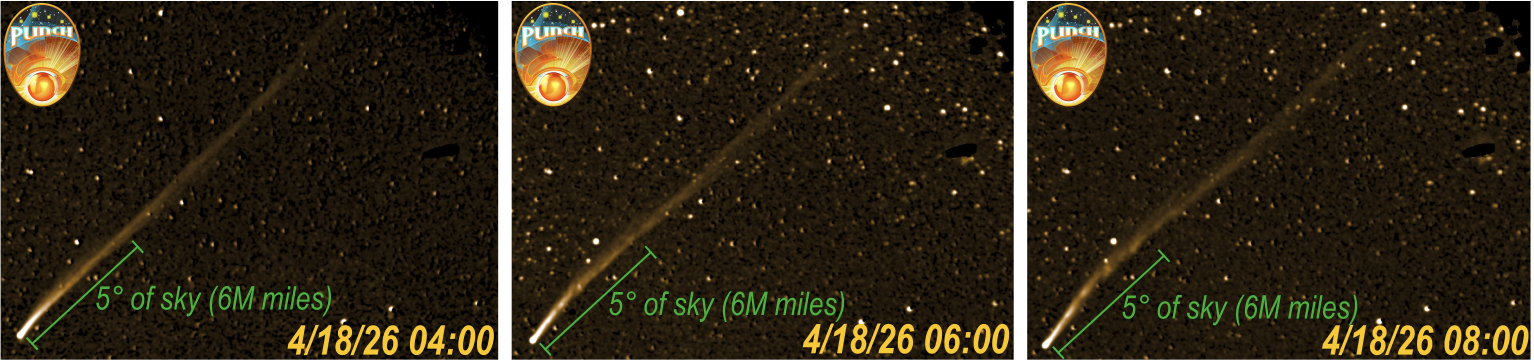\n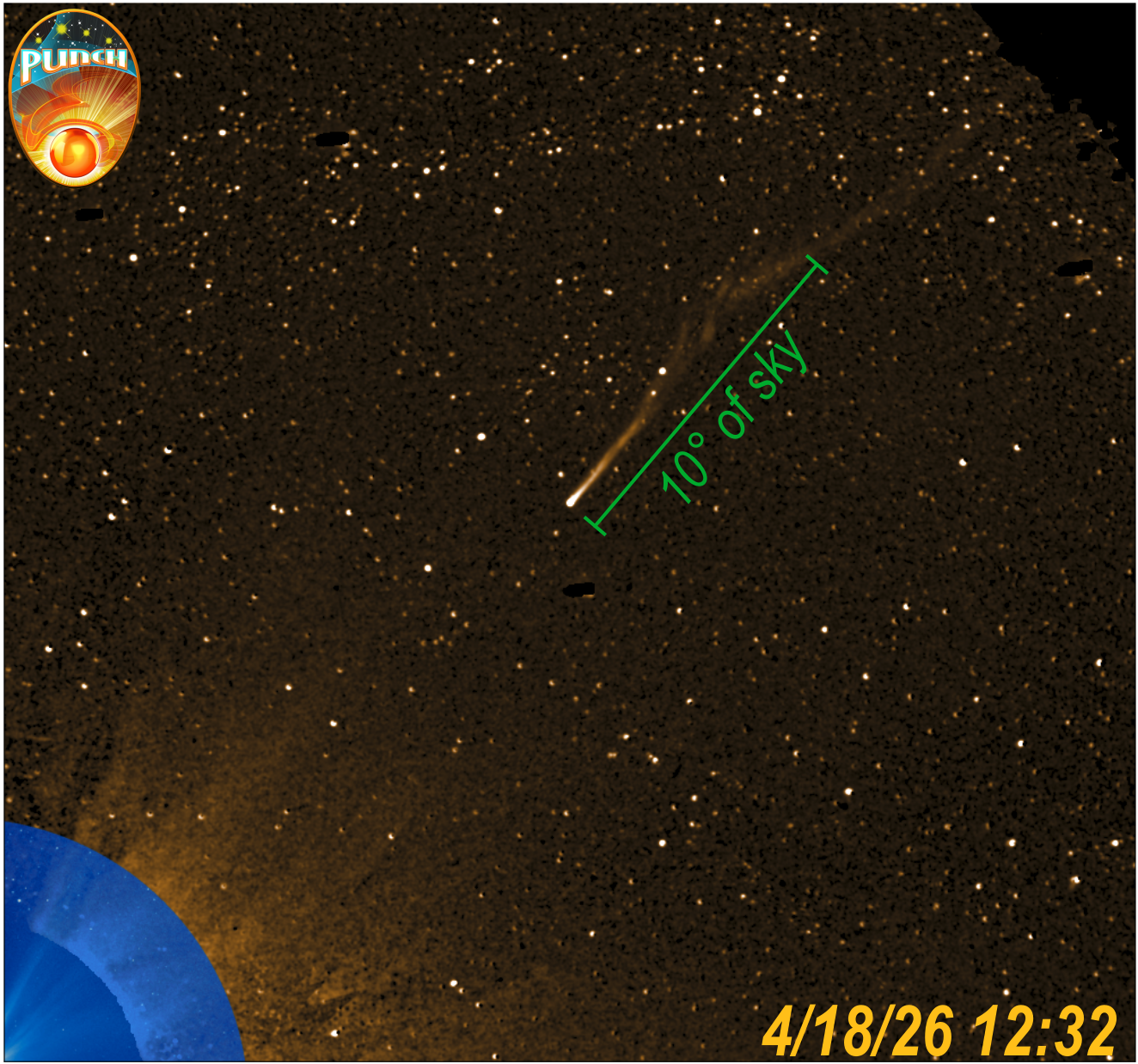\n*PUNCH captured the breakup of Comet Pan-STARRS’ tail in April 2026, as a shear layer in the solar wind washed past the comet. In just two hours the tail developed a “vortex train” spanning roughly 8 million miles (top). The vortices continued spinning and developing for many hours (bottom). The observation is [available as a movie](https://drive.google.com/file/d/1dZfzw7toAeI5_eSHRHLP3hNDTL4qPbjX/view). (download for best resolution)*\n\nThe [PUNCH mission](https://punch.space.swri.edu) observed an unusual breakup of a comet tail into spinning vortices, highlighting that the solar wind is a turbulent fluid, not just a “stream of particles” leaving the Sun. An 8-million-mile-long stretch of Comet Pan-STARRS’ tail transitioned from smooth flow to a series of evenly-spaced, spinning knots of material, each of which is 10x larger across than Earth itself, in just two hours. PUNCH’s continuous 8-minute coverage revealed the transition and subsequent evolution of the tail. \n\nThe transition appears to have been due to a shear layer in the solar wind, where two different streams of material slide past one another, as in the “wind shear” events that sometimes disrupt air traffic inside Earth’s atmosphere. The shear caused the smooth-flowing comet tail to break up into a train of large-scale turbulent eddies.\n\nThe space between planets is far from empty. Comets provided the first evidence of what we now call the “solar wind”: by the 1950s, comet tails had been seen to respond to disturbances in a then-unknown medium between the planets. The solar wind is so tenuous, with just a few thousand atoms in every liter of “empty” space, that essentially no solar-wind atom ever collides with any other. \n\nBut the atoms do exchange momentum with one another, via the electric and magnetic fields. So they act collectively as a classical fluid, governed by the same equations that control terrestrial weather, jet aircraft, and even the flight of a golf ball. The observed tail breakup is analogous to shear-induced “dust devils” on Earth – but on a cosmic scale.\n \nThis is PUNCH Science Nugget #36. PUNCH nuggets are archived at [https://punch.space.swri.edu/punch_news_archive.php](https://punch.space.swri.edu/punch_news_archive.php). \nYou can subscribe to PUNCH nuggets by email: [https://forms.gle/XVNjURj2izVzMrct8](https://forms.gle/XVNjURj2izVzMrct8).\n",
"createdAt": "2026-06-26T05:20:14.482Z",
"theme": "github-light",
"title": "Comet Pan-STARRS vs. The Solar Wind",
"visibility": "public"
}