{
"$type": "com.whtwnd.blog.entry",
"blobs": [
{
"name": "Screenshot 2026-05-01 at 9.12.44 AM.png",
"blobref": {
"$type": "blob",
"ref": {
"$link": "bafkreia27ccwwrhzskyi33pdvternbk4oj7ym6fg4ftr7otfm6tdypvtey"
},
"mimeType": "image/png",
"size": 2624887
},
"encoding": "image/png"
}
],
"theme": "github-light",
"title": "PUNCH Tracks CMEs with Height-Time Maps ",
"content": "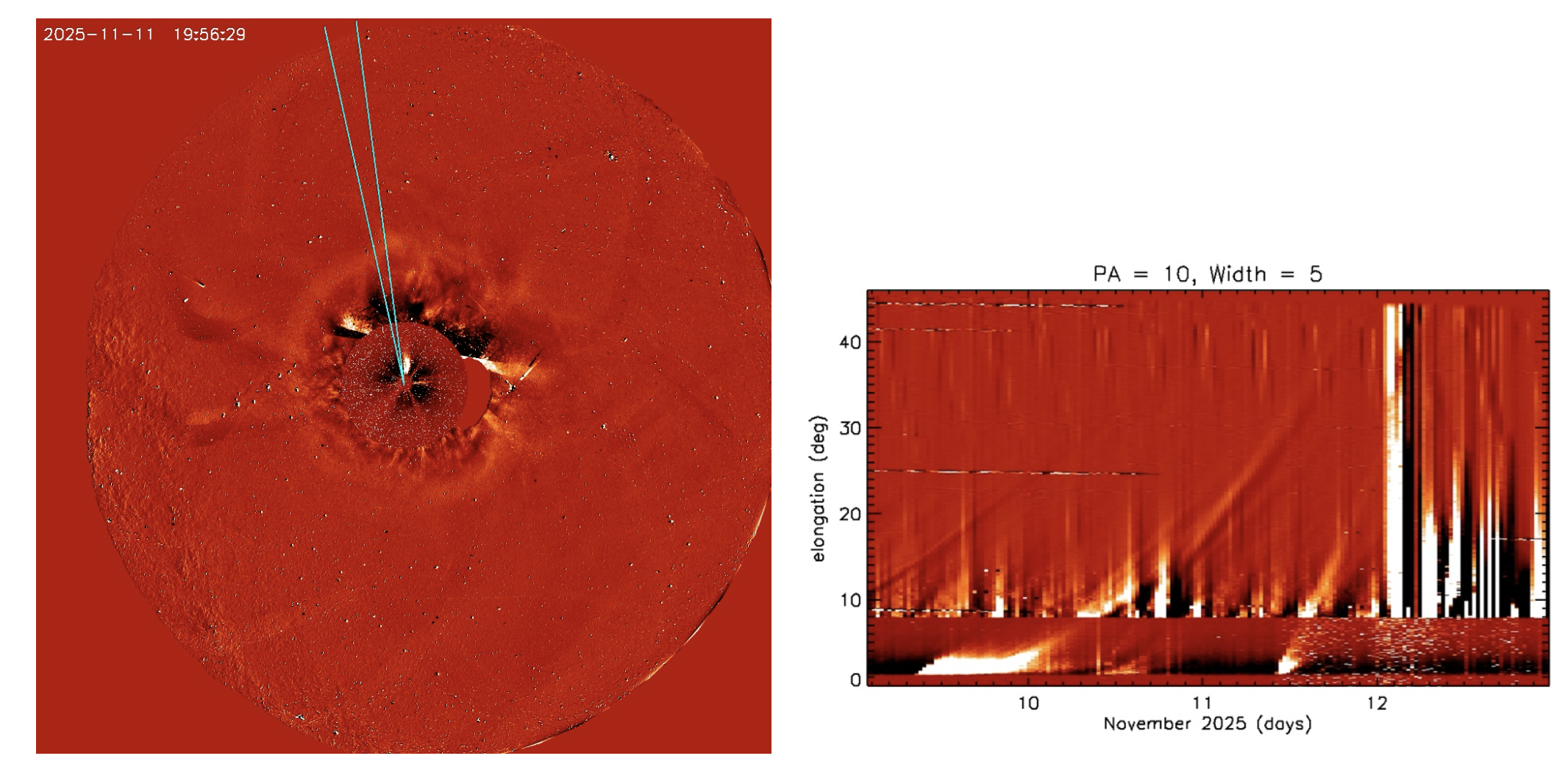\n*Left: PUNCH Wide-Field Imager (WFI) difference image with embedded SOHO LASCO C3 coronagraph image showing a coronal mass ejection (CME) in November 2025 overlaid with a 5° (position angle) radial wedge (blue lines). Right: Height (elongation-angle, ε)-time intensity plot constructed by stacking consecutive images of that radial wedge from left to right. Note the particle storm in C3 (ε < 8°) and saturated WFI data (ε > 8°) on Nov. 12, possibly caused by geostorm aurora.*\n\n\nPUNCH produces composite white light images of half the sky, centered on the Sun, every ~30 min. PUNCH Scientists (T. Kuchar & D. Webb) use consecutive images over a period of hours to days to track Coronal Mass Ejections (CMEs) and other transient outflows, using height-time maps. \n\nWe first make \"difference images\" by subtracting a previous image from each time step, minimizing background elements such as stars, and enhancing outward motions, such as CME fronts.\n\nWe make height-time maps by stacking (from left to right) a radial wedge from consecutive difference images containing a CME[1,2]. The wedge is centered on a given position angle (PA) measured 0-360º CCW around the Sun), e.g., PA=10° (see Figure) and averaged across the width of the wedge (to enhance the signal to noise; here wedge width=5º). The result is solar brightness plotted on a height-time plot as in the Figure (right panel), where height is \"elongation\" or angular distance from the Sun, ε. If the image has missing or bad data, we use a blank line to maintain the cadence of the measurements.\n\nThe inclined tracks in the right panel show the velocity and direction of outward-propagating transients. The geometrical shapes of these tracks depend on the propagation characteristics of the transient. For example, the shape may indicate acceleration of the CME or (for large ε and assuming constant velocity) whether the CME front lies within the plane of the sky (straight line), or is directed Earthward (curves upward), or is directed anti-Earthward (curves downward). In addition, such plots can be used to track Stream Interaction Regions (SIRs)[3], which can appear as converging tracks.\n\n-----------\n\nReferences:\n\n[1] Sheeley et al., Astrophysical Journal 675, 853 (2008).\n\n[2] Davies et al., Geophysical Research Letters 36, L02102 (2009).\n\n[3] Rouillard et al., Geophysical Research Letters 35, L1011 (2008).\n\n-----------\n\n*This is PUNCH Science Nugget #33. PUNCH nuggets are archived at [https://punch.space.swri.edu/punch_news_archive.php](https://punch.space.swri.edu/punch_news_archive.php).\nYou can subscribe to PUNCH nuggets by email: [https://forms.gle/XVNjURj2izVzMrct8](https://forms.gle/XVNjURj2izVzMrct8)*.",
"createdAt": "2026-05-01T16:13:48.911Z",
"visibility": "public"
}