{
"$type": "com.whtwnd.blog.entry",
"blobs": [
{
"name": "sigma.jpg",
"blobref": {
"$type": "blob",
"ref": {
"$link": "bafkreid7wi2nfuvvtqswdpvw2eeoxwqlx2qo7mkorbqprgsiifyz7i5rfi"
},
"mimeType": "image/jpeg",
"size": 65850
},
"encoding": "image/jpeg"
}
],
"theme": "github-light",
"title": "The Journey to 0.1% Photometric Calibration",
"content": "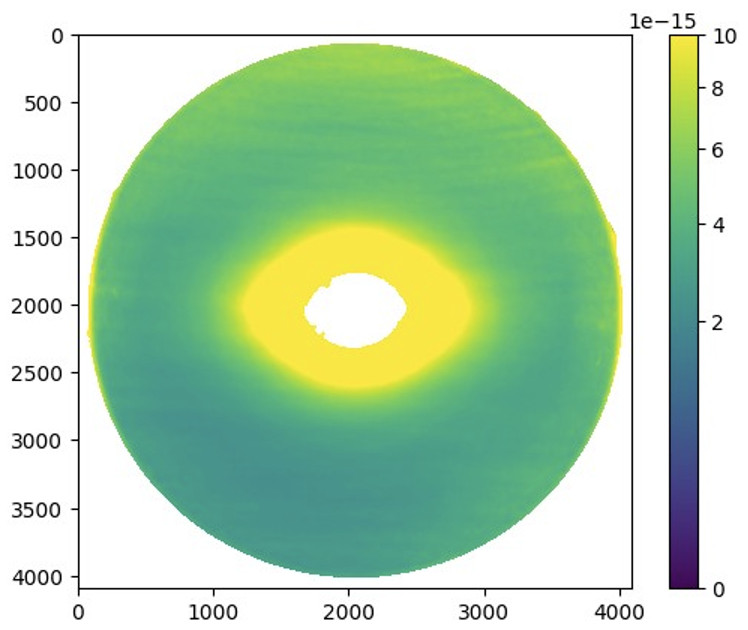\n*A flat-field data product shows “typical” amount of starfield variation across most of the PUNCH\nfield of view, and photon noise level (associated with the solar F corona) near the center.*\n\nPUNCH is doing something very ambitious: merging together images from four separate\ninstruments mounted on four separate spacecraft. Doing so requires very, very precise\ndetermination of the conversion between each pixel’s value and brightness on the night sky.\nThat’s because, in one 90-minute orbit, the same feature on the sky is imaged by at least eight\ndifferent pixels across different regions of at least three different cameras. Combining those data\nrequires us to know exactly how to convert the value of each pixel to brightness on the sky.\n\nOn the ground, we measured the “flat field” sensitivity of each camera, using smoothly illuminated\noptical diffusers. But those are only good to something like ten-percent precision, which is not\nnearly precise enough. PUNCH uses the sky itself. Initial measurements of the “optical gain”\nfunction used the brightnesses of individual stars. But those run into difficulty, because of\nsomething else – optical aberration, which moves photons from the core of a star’s image to a\nsmeared-out “coma”. The aberration is typical of most optical systems (the first paper to complain\nabout it was written by some guy named Johannes Kepler, together with his Italian buddy Galileo\nGalilei, in 1611). We correct it on the ground, using [complicated mathematics](https://ui.adsabs.harvard.edu/abs/2023AJ....165..204H/abstract). Tracking individual\nstars also leads to a host of other difficulties. So we’re checking that work using a simple cross-\ncomparison process.\n\nWe took each of about 1,500 PUNCH images of the sky and projected them from the camera\nframe to the heliocentric output plane of the PUNCH constellation, and then measured how much\neach neighborhood varied in brightness. Merging all of those produced the image above: a σ-\nmap (“sigma map”) of the typical amount of brightness variation in each neighborhood of the\noverall PUNCH field of view, averaged across all of the cameras in PUNCH.\n\nThe next step is to remap all of those average brightness variation levels back to the focal plane\nof each of the 1,500 images. Then we can compare the variation in each neighborhood of each\ncamera, to the PUNCH consensus average on the sky itself. That gives us a map of how each\ncamera responds, and allows us to cross calibrate them to within a small fraction of a percent.\n\nThere’s one issue: see that bright yellow “doughnut” in the middle of the figure? That is the part\nof the image that is dominated by photon counting noise: quantum uncertainty in the amount of\nenergy that hit the detector at that location. For most of the figure, the brightness of the figure is\nproportional to the sensitivity of the camera, but photon counting noise isn’t. It varies more like\nthe square root of the sensitivity of the camera. So we can’t use this method to measure the flat\nfield too close to the Sun. But it works like a champ over most of our field of view.\n\nAnother minor issue is that you can see some horizontal banding near the top and bottom of the\nimage. Those are statistical imprints left by bright stars as they cross through the field. But they\nfade when we scale up to the full analysis, using the over 80,000 clear images (and over 160,000\nimages for each polarizer position!) we have collected so far in the mission.\n\nPUNCH data analysis is simple in concept – but when high precision is involved, almost\neverything grows more finicky and complicated. We’re making great progress, and rolling out\nnew versions of the data every couple of weeks. They are only growing more spectacular with\neach release.\n\nVersion 0h of the data, which will start appearing in NASA’s Solar Data Analysis Center archive\nover the next few days, achieves roughly 1% relative photometric precision over most of the field\nof view. We still have work to do, but we’re getting there!\n\n*This is PUNCH Nugget #23. PUNCH nuggets are archived at the [PUNCH mission website](https://punch.space.swri.edu). You can [sign up to receive PUNCH nuggets by email](https://forms.gle/XVNjURj2izVzMrct8).*",
"createdAt": "2025-10-29T21:17:02.141Z",
"visibility": "public"
}