{
"$type": "com.whtwnd.blog.entry",
"blobs": [
{
"name": "layup-bsky.jpg",
"blobref": {
"$type": "blob",
"ref": {
"$link": "bafkreic4pcnrqruwcgf7opzsrobfws6e4h2mztfitzjkoac4ximu2xibxu"
},
"mimeType": "image/jpeg",
"size": 1007310
},
"encoding": "image/jpeg"
},
{
"name": "layup.png",
"blobref": {
"$type": "blob",
"ref": {
"$link": "bafkreifmb5gg4bhlzoshlsop7soiajye5nsr6k3td3dg36pomge5bhc4xu"
},
"mimeType": "image/png",
"size": 15401491
},
"encoding": "image/png"
}
],
"theme": "github-light",
"title": "PUNCH Tracks A New Comet: C/2025 R2 (SWAN)",
"content": "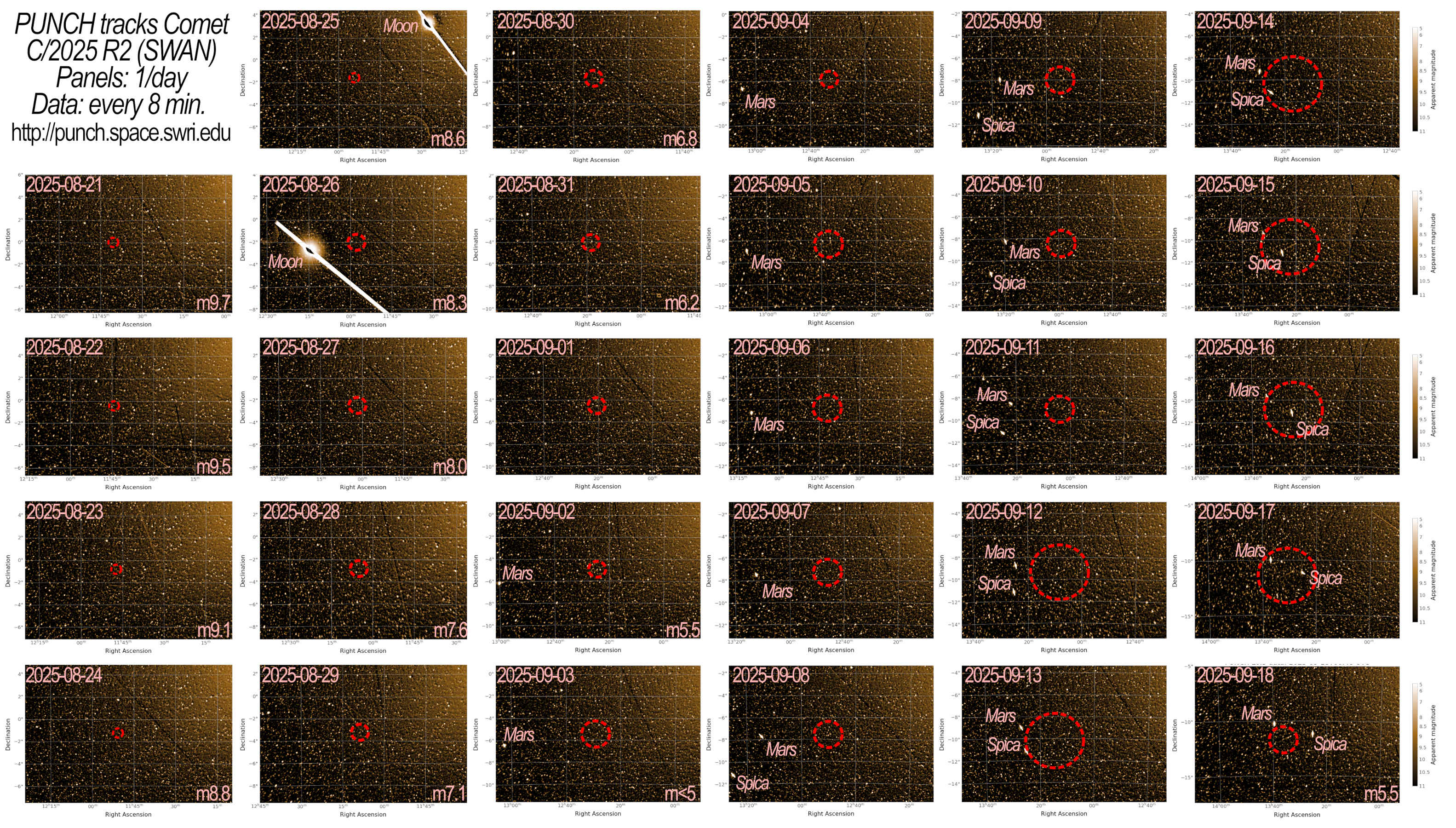\n\n*PUNCH detected comet SWAN for weeks before its discovery last week (11-Sep-2025).\nTracking the comet is a warmup for tracking the upcoming 3I interstellar comet, which will enter\nthe PUNCH FOV this weekend (21-Sep). Where the comet appears as a point, its astronomical\nmagnitude is shown at lower right of the panel. Some other objects are labeled too. (This image is also available at higher quality as a [15 MB PNG](https://psathyrella.us-west.host.bsky.network/xrpc/com.atproto.sync.getBlob?did=did%3Aplc%3Add6rbxnc4ostg26plpmonhcz&cid=bafkreifmb5gg4bhlzoshlsop7soiajye5nsr6k3td3dg36pomge5bhc4xu).)*\n\nLast week, astronomers announced [a new comet, designated C/2025 R2 (SWAN)](https://en.wikipedia.org/wiki/C/2025_R2_(SWAN)), that was first\nseen in [Lyman-α](https://en.wikipedia.org/wiki/lyman_alpha) images from the [https://sohowww.nascom.nasa.gov](SOHO spacecraft). Since mid-August, PUNCH has\nbeen observing this comet (along with every other object within 45° of the Sun). PUNCH collects\ndata at a 4-minute cadence in polarized light and at an 8-minute cadence in unpolarized light.\n\nWe have created a montage showing once-per-day close-up frames, highlighting the\ncomet’s appearance. To form its \"virtual instrument”, PUNCH combines and calibrates data\nfrom four separate spacecraft. The starfield close-ups in the montage demonstrate that our data\npipeline is functioning well, as the Science Operations Center (SOC) team continues to refine it.\n\nPUNCH’s resolution is similar to that of the human eye, but it is far more sensitive. In a\nsingle image, PUNCH can detect small, bright objects that are up to 100 times fainter than the\nfaintest star visible to the naked eye under ideal conditions (astronomical magnitude 10.5+).\n\n*This is PUNCH Nugget #21. PUNCH nuggets are archived at the [PUNCH mission website](https://punch.space.swri.edu/news). You can [sign up to receive PUNCH nuggets by email](https://forms.gle/jsKAzv3bUACJi3jx9).*",
"createdAt": "2025-09-19T22:44:57.099Z",
"visibility": "public"
}