---
> Despite the countless failed attempts at trying to democratize coding while
> not understanding coding, we’re faced with the reality that you cannot
> understand code without engaging with it.
-Lars Faye,
> Agentic Coding is a Trap
Lars’s blog post got me thinking: what if we designed a deliberately slow,
hand-holding agent? One that keeps the human programmer involved, to understand
and learn. One that doesn’t paint you into a corner with slop. No one-shotting,
no agentic looping, but instead moving at a human pace to match your particular
human knowledge at the time. I use the word programmer on purpose because I
think even vibe coders should at least be learning programming concepts, like
what data their app needs to store and how, or where that data travels (say,
from their laptop to a data center in Ohio then into a database somewhere else).
We’ll call this Slow Mode.
Slow Mode 1.0 with Claude Code
As a low stakes experiment, I first wrote Slow Mode 1.0 as instructions in
for
using Claude Code + the Val Town MCP server:
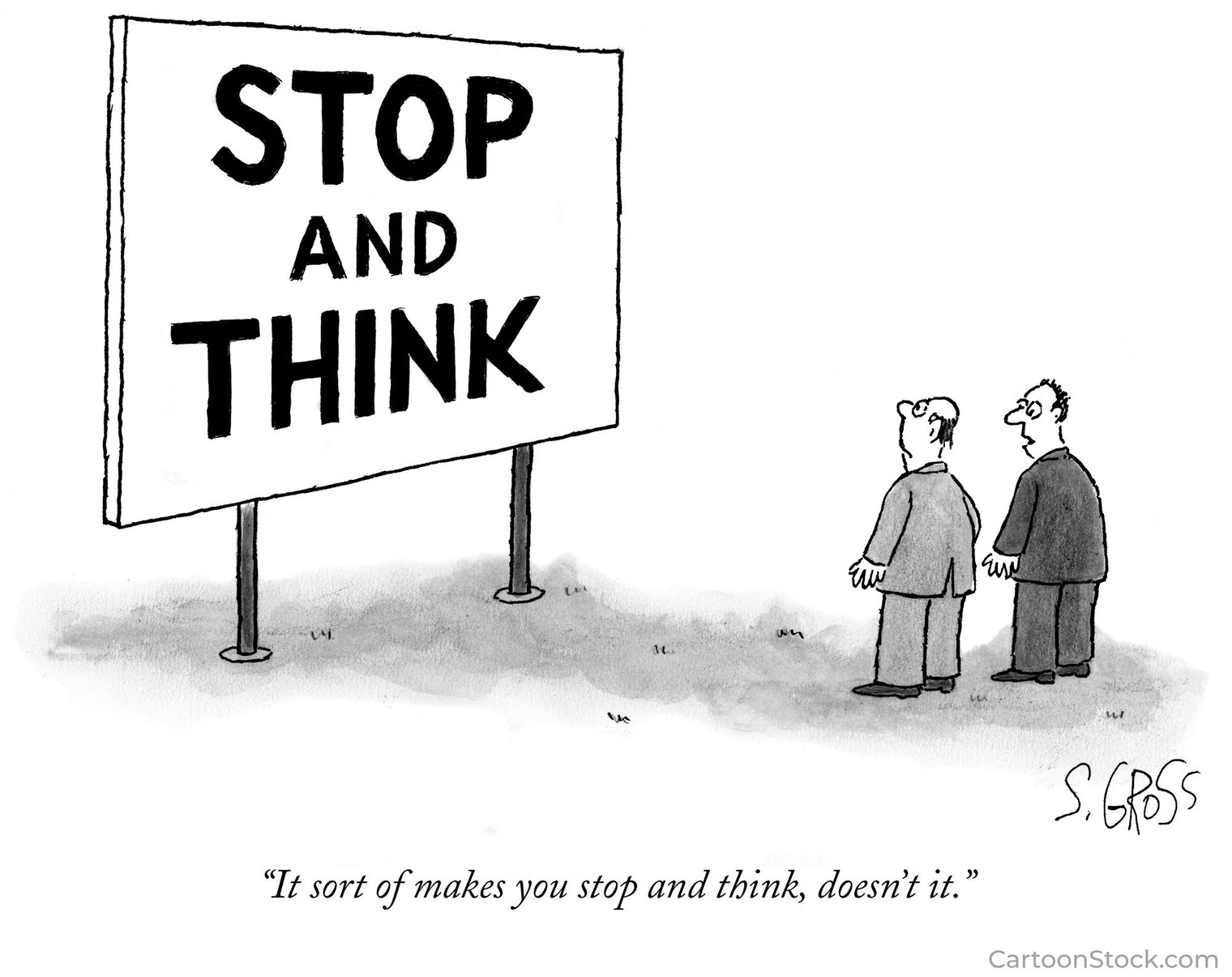
Stop and think
Of course, when an LLM thinks or reasons, it is really just generating more
and more text.
> ...the models can only “think” by spooling out more text — while human
> thinking often does the opposite: retreats into silence, because it doesn’t
> have words yet to say what it wants to say.
-Robin Sloan,
> Thinking Modes
LLM “thinking” can be problematic, assuming it’s important to me to understand
what’s happening. I’d actually like to see the thought process, if you can call
it that. In some ways, I think it’s a feature, not a bug, that a slow mode agent
would brainstorm linearly, token by token. It’s the machine’s way of
rubber ducking, and I
think we should be doing it together. I should be talking aloud and then
dictating or typing the next decision or question back to my robot
collaborator-teacher. I should be making some edits in the code myself,
extracting a helper function here, renaming a variable there, running the code,
poking around the database. I like that my slow agent keeps me in the weeds, so
I can keep the whole program in my head. Like this:
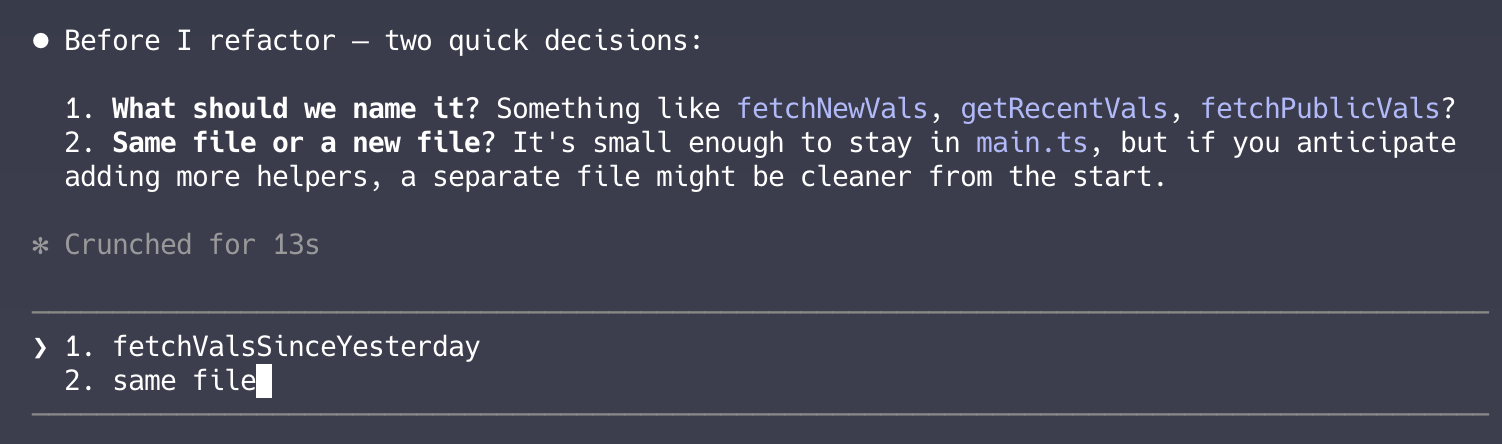
I find coding in Slow Mode to be more pleasant. It’s partially the prompt
enforcing Slow Mode, but in large part it’s also me self-enforcing by staying
focused and thinking (much easier when your agent doesn’t run off for 10 minutes
in a loop!). Slow is smooth, and smooth is fast.
Slow Mode 2.0 (Slow Townie)
After experimenting with Slow Mode using Claude Code + Val Town MCP, we’ve
started privately testing Slow Townie within Val Town.
The instructions are pretty much the same as above in for now, but
an ideal slow mode would factor in your particular knowledge and preferences,
building on the “memory” feature that many agents currently use. We should have
a lot to learn from prior art when it comes to personalization.
YOLO Mode
The polar opposite of Slow Mode is YOLO Mode, where your agent loops again and
again without stopping to ask for permission. It fulfills vibe coding’s original
definition. In Townie we do have YOLO Mode (a.k.a. “Allow all”) because, well,
to each her own. I enjoy YOLO’ing sometimes, typically when the stakes are low
and time is short.
But more often than not, it’s important to me that when I need a break—when I
shut the laptop to go for a walk or cook dinner or sleep—my robot takes a
break, too. Contrary to what seems like consensus among tech workers in San
Fransisco, I think my agent should mostly stop working when I do (and I myself
should probably stop working around dinner time most nights!). Plenty of
developers I respect feel the opposite—fair enough.
Trading productivity for learning
Val Town’s end goal is end-user programming, the dream that anyone should be
able to customize their own software. Like a spreadsheet, there should be a
natural gradient from beginners making something useful in the first hour to
experts spending hundreds of hours on complex models. Users progress along that
gentle slope by learning continuously over time. But is end-user programming
about learning, or about building the thing? I think it’s about both: the more
you learn while building, the better you get at building.
There’s an inherent learning-versus-productivity tradeoff when using AI. I am no
stranger to
sacrificing my own learning
or solid understanding of an implementation to prioritize shipping. When you
have a lot on your plate, that can be the right side of the tradeoff. But
there’s also a
short-term gains versus long-term maintenance
tradeoff, and I’m betting Slow Mode will help with that.
Learn to cook
I know many people think moving more slowly means falling behind, or worse, that
by insisting on understanding code we’re gatekeeping. By embracing Slow Mode at
Val Town, we’re telling vibe coders we believe in your ability to learn
fundamentals about code that might’ve previously seemed unreachable. Building in
Val Town (or elsewhere) with Slow Mode should empower you. You should feel like
you know what you’re doing, not like you’re dependent on your agent and helpless
if there’s downtime.
It’s like cooking with recipes versus learning about food fundamentals so you
can improvise in the kitchen and create food that’s all your own. Val Town is
the Salt Fat Acid Heat of vibe coding platforms.
Prior art
We’re not the first to propose something like Slow Mode. It turns out Claude
itself already has a
“Learning mode,”
ostensibly for education but also relevant to professional and hobbyist (vibe)
coders. ChatGPT has “study mode”
(also more geared toward students). Just last week, the same day I wrote the
first draft of this very essay, a Claude/Codex Skill for “deliberate skill
development” attracted a bunch of GitHub stars and Hacker News comments.
Just like Val Town
fast-followed all the best coding assistants
while building Townie, we’d like to learn from others and share our own
improvements to Slow Mode along the way.

Discussion in the ATmosphere